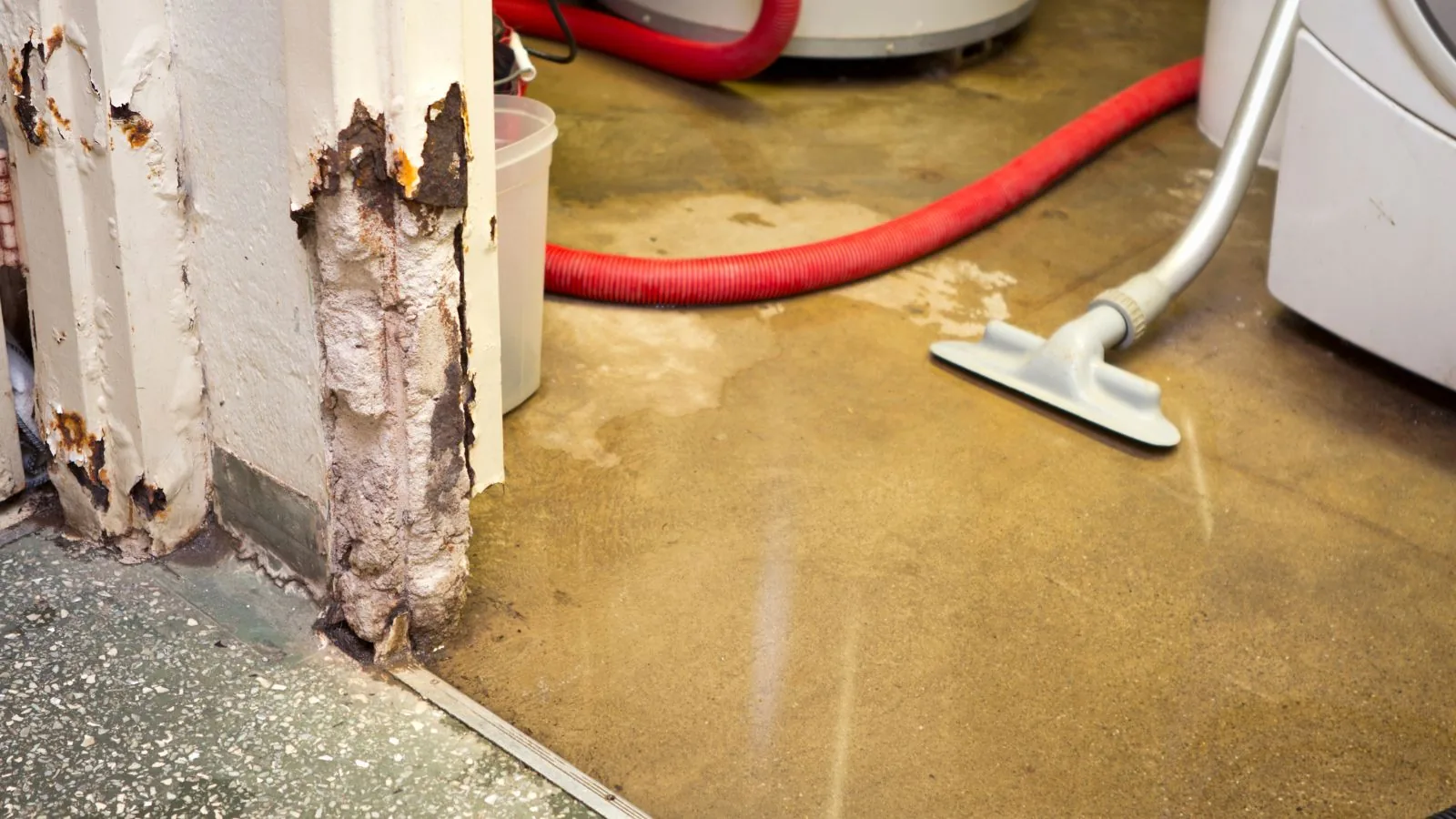
Water heater leak cleanup is the removal of water and the drying of floors and walls after a tank or its connections have failed. Most tanks hold dozens of gallons, and a split seam or a failed valve can release all of it onto the floor. If your unit is leaking in Morganville, shut off the supply and the power, then call the 24/7 emergency line.
The tank itself is a plumber's repair. What lands on us is the water: the utility room floor, the wall base, whatever was stored nearby and any finished space the water reaches. For leaks that start at a supply line rather than the tank, burst pipe water damage describes that source.
A leaking water heater is an emergency
Cut the cold supply
Close the cold-water shutoff valve above the tank. This stops refilling and slows the leak.
Power off
For an electric unit, turn off its breaker only if you can reach the panel on dry ground. For gas, turn the control to the off or pilot position, and leave if you smell gas.
Do not touch hot water
A tank can leak scalding water. Keep children and pets away and avoid standing in the puddle.
Move what is nearby
Clear stored boxes, paint cans and anything that wicks water off the floor.
Why water heaters fail and where the water goes
Tanks usually fail at the bottom seam after years of sediment and corrosion, or at a connection, a relief valve or a drain valve. A slow drip can run for weeks, while a seam failure releases the whole tank within minutes. Water finds the lowest route, which in many homes means under a wall into a finished room next to the utility space.
Because most water heater water is clean supply water, it is typically Category 1 at first. If it sat on the floor for a long time or touched debris, it can degrade to Category 2. That is one reason speed matters.
Signs your water heater is leaking
- A puddle or a damp ring on the floor around the base.
- Rust streaks on the tank or the connections.
- A drip at the relief valve discharge pipe.
- Higher water bills or the sound of dripping near the unit.
- A stained wall base or floor in an adjoining room.
How the cleanup works
Extraction removes the standing water, and moisture meters then check the floor, the wall base and any adjoining rooms, as the ANSI/IICRC S500 standard describes. Drywall wicks water upward, so baseboards and the bottom of the wall are commonly opened to dry the cavity. Air movers and a dehumidifier finish the job.
Replacing the unit is a plumber's task, and permit rules vary, so ask the Marlboro Township Construction Division, which enforces the New Jersey Uniform Construction Code, whether a replacement needs a permit. Cleanup can proceed while the plumbing is arranged.
Tank leaking? Call the emergency line and tell us how much water you are seeing.
Call (732) 352-9660What changes the cost of water heater leak cleanup
Tank size and leak duration
A slow drip over weeks and a tank dumped in minutes affect different areas.
Flooring in the area
Concrete dries quickly. Finished floors next door take longer and may need removal.
Wall base and drywall
Wicking into drywall adds cut-outs and drying.
Stored contents
Wet cardboard and soft items are sorted and often discarded.
Drying days
Equipment runs until moisture readings are normal.
Insurance coverage often turns on whether the failure was sudden and accidental. A long-running leak from corrosion may be treated differently. Check your policy and ask your insurer. Want your real number? Call (732) 352-9660.
Related work and nearby towns
If water reached a finished room, carpet water damage restoration and hardwood floor water damage repair describe those surfaces. When the utility space is below grade, basement water damage cleanup adds what basements need. We take water heater calls from Cliffwood too.
Frequently asked questions
Yes. Tanks fail at all hours, so the emergency line is staffed around the clock, every day. Call (732) 352-9660 after you shut off the supply and the power.
Same-day response is offered when crews are available. There is no promised arrival time.
Shutting off the supply and power is safe and wise. Repair or replacement should be done by a licensed plumber, and for gas units by someone qualified to handle gas.
Many household tanks hold dozens of gallons. A seam failure can empty a tank within minutes, though a connection leak can drip for weeks.
Usually it starts as clean supply water. If it sat for a long time or touched debris, it can become Category 2, which changes what can be saved.
Many policies cover sudden water damage from a failed tank but not the tank itself or a leak from long-term wear. Check your policy and ask your insurer.