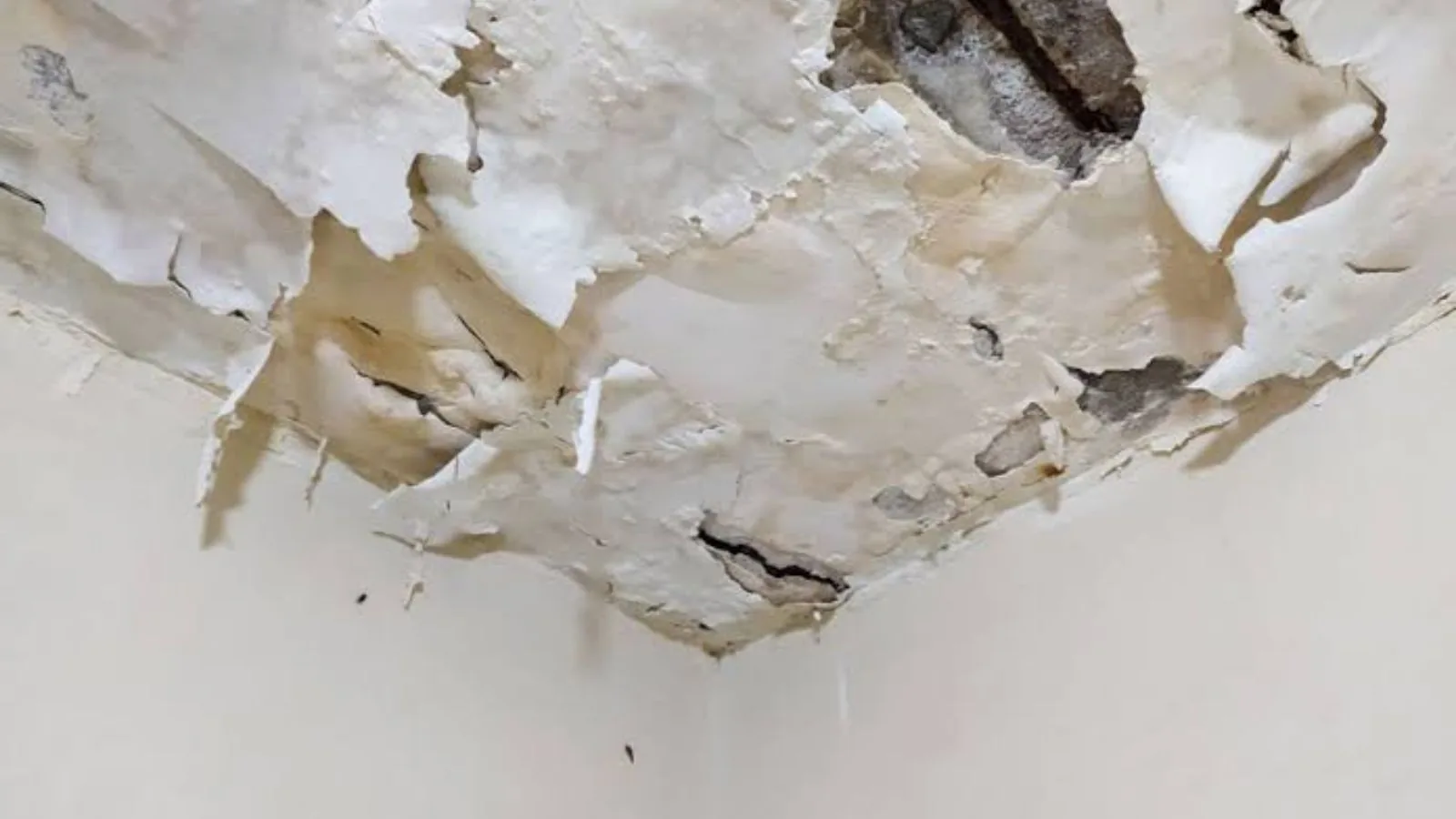
Ceiling water damage is a stained, sagging or dripping ceiling and the wet insulation, framing and drywall above it. It is an emergency when water is actively coming through, since a ceiling holding water can drop suddenly. Our line in Morganville is open 24 hours a day, and the safest first moves are to stay out from under the bulge, move belongings and call.
This page also covers roof leaks, because a roof leak and a ceiling stain are the same problem from two ends. The visible damage is the ceiling, and the source might be the roof, an upstairs bathroom, a supply line or an air handler in the attic. We deal with the water and the damaged ceiling, and a roofer or plumber fixes the source.
A dripping or bulging ceiling is an emergency
Stay out from under it
A bulging ceiling is holding water. Keep people and pets away from the area below it.
Relieve it safely
For a small bulge, a bucket underneath and a small pinhole in the lowest point can drain it in a controlled way. Do this only if you can stand clear of falling material.
Protect the room
Move furniture and electronics out of the way and cover what cannot move with plastic.
Mind the light fixture
If water is coming through a fixture, do not use the switch. Cut power at the panel only if you can reach it dry, or call 911 or the electric utility.
Where the water is coming from
- The roof, through a damaged shingle, flashing, a vent boot or a chimney joint.
- A bathroom or laundry above, through a supply line, a drain or a worn seal.
- A pipe running through the ceiling cavity.
- An HVAC unit or drain pan in an attic.
A stain that grows after rain points to the roof. A stain that appears under a bathroom, or that grows with no rain, points to plumbing. We track the source with moisture readings and tell you what we find so the right tradesperson can fix it.
Roof leaks and what they do to the ceiling below
Water from a roof leak soaks roof decking and attic insulation before it ever reaches the ceiling, so the stain is usually the last stage. By then the insulation is wet and heavy, and it is often the reason the drywall sags. We open the ceiling where needed to remove wet insulation and check the framing above for staining.
The Office of the New Jersey State Climatologist notes that 2018 was New Jersey's wettest year, with Monmouth and Ocean counties hit by heavy rain on August 13 of that year. Years like that expose weak flashing and worn shingles. If your ceiling stained after a heavy rain, have the roof inspected soon, since a patched ceiling under an open roof will stain again.
How ceiling damage is repaired
Wet drywall and insulation are cut out, the cavity is dried with air movers and a dehumidifier, and moisture readings confirm it is dry before anything is closed up, as the ANSI/IICRC S500 standard describes. Stains from an old leak are sealed with a stain-blocking primer before paint. A bubbled but intact ceiling can sometimes be dried and repainted, while a sagging one is replaced in sections.
| Ceiling condition | Usual approach | Why |
|---|---|---|
| Faint stain, no sag, dry | Find the source, prime and repaint | The water is gone and the drywall is sound. |
| Bubbled or peeling paint | Dry the cavity, then repair the surface | Moisture is likely still in the drywall. |
| Sagging or soft | Cut out and replace the section | Wet gypsum loses strength and can fall. |
| Dripping now | Contain, extract, open and dry | Active water needs controlling before repair. |
Condominium and townhouse communities such as Millponds and Chelsea Square put units above and below one another, so tell the association as well as your insurer when a ceiling stain traces to a neighbor's plumbing.
Stain spreading or ceiling dripping? Call the line and describe what you see.
Call (732) 352-9660What changes the cost of ceiling water damage repair
Source of the water
Fixing the roof or pipe is separate from the ceiling work, and the source determines how far the water traveled.
Area of ceiling affected
A single stained panel and a whole room are very different scopes.
Insulation and framing
Wet insulation is replaced, and the framing is dried or in rare cases treated.
Ceiling texture and finish
Matching popcorn, knockdown or smooth finishes affects labor.
Drying and rebuild
Mitigation and drywall, texture and paint are priced separately.
Homeowners policies often cover water that enters through a storm-damaged roof but may not cover a leak from long-term wear. Check your policy and ask your insurer. We explain scope and price before work starts. Want your real number? Call (732) 352-9660.
Related work and nearby towns
If the ceiling failed because of a pipe, burst pipe water damage explains the shutoff steps. Wet walls below the stain are covered by wall and drywall water damage repair, and heavy rain damage across the whole house falls under storm water damage cleanup. We also help homeowners in Matawan with ceiling leaks.
Frequently asked questions
Yes. A ceiling that starts dripping at midnight cannot wait, so the emergency line is answered 24 hours a day, every day. Call (732) 352-9660 and describe the stain or the sag.
Same-day response is offered when crews are available, with no promised arrival time.
Roof leaks are covered here, because the ceiling and the roof problem are the same job. We handle the water damage inside, and a roofer repairs the roof.
Only if you can stand clear and a bucket is underneath. Draining a bulge in a controlled way is safer than letting it release unexpectedly. If the ceiling is large or sagging, call us instead of trying it yourself.
A stain from an old leak can bleed through ordinary paint, so a stain-blocking primer is used. Painting over a still-wet ceiling traps moisture, so the cavity must be confirmed dry first.
As soon as possible. The EPA advises drying wet materials within 24 to 48 hours to limit mold growth, and wet insulation above the ceiling can stay damp much longer than the surface.