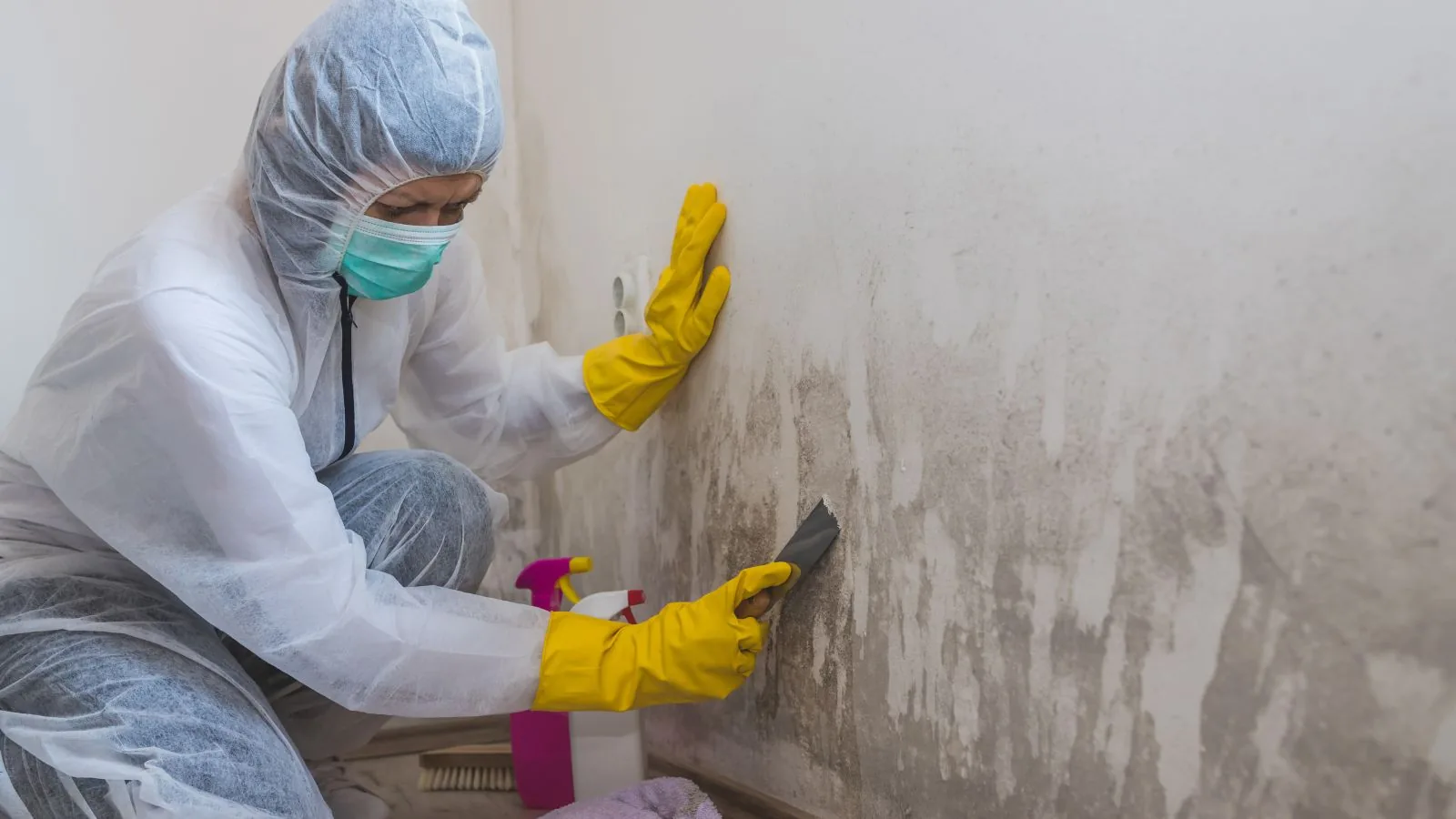
Musty smell, dark spots or a past leak: do you have mold?
A musty smell, dark spots on a wall or ceiling, peeling paint or a leak that was never fully dried can all point to mold. Mold needs moisture to grow, so any mold question starts with water: where it came from, whether it is still present and how long materials stayed wet. In Morganville, the usual starting points are a past pipe leak, a roof stain, a damp basement or a crawl space.
Mold remediation is the assessment of affected areas, the control of the moisture source and the removal or cleaning of contaminated materials under containment. We follow the ANSI/IICRC S520 standard for professional mold remediation. This page does not diagnose health effects, and questions about health belong with a physician.
Testing and inspection: what each one tells you
An inspection looks at where moisture entered, what materials are affected and how far growth extends. A moisture meter and a thermal camera show wet areas behind surfaces. Sampling, where used, can confirm the type and amount of airborne or surface spores, but sampling alone does not tell you the source or the scope.
Visible growth and a known water event often make the plan clear without lab work. When there is a smell and no visible growth, inspection plus targeted sampling can help locate the hidden source. We explain the choice and the cost before anything is done. Real estate and lender questions are covered in the FAQ below.
| Step | What it does | What it does not do |
|---|---|---|
| Visual inspection | Finds visible growth and staining | Does not see inside wall cavities. |
| Moisture meter and thermal camera | Locates wet materials | Does not identify mold species. |
| Air or surface sampling | Measures spores present at the time | Does not locate the water source. |
| Post-remediation check | Confirms cleanup and dryness | Does not predict future moisture. |
Moisture is the cause, so the water source comes first
The EPA states that moisture control is the key to mold control, and that if mold is a problem you must clean it up and fix the water problem. Cleaning mold without fixing the leak means it returns. That is why this page ties closely to the water pages: structural drying removes the moisture, and the source pages such as burst pipe water damage, ceiling water damage repair and crawl space water damage cover the leak.
If the water event was recent, drying within 24 to 48 hours is the best protection. If it was longer ago, assessment tells us whether materials are still wet.
What to do and not do
Stop the water
Fix or isolate the leak. Mold cleanup cannot succeed with active moisture.
Do not disturb it
Scrubbing or sanding can spread spores to other rooms. Keep the area closed off.
Do not paint or caulk over it
The EPA advises against painting or caulking over mold.
Do not mix cleaners
Never mix bleach and ammonia. It creates dangerous fumes.
How remediation works
Containment keeps spores from spreading, with plastic barriers and negative air where needed. Affected porous materials such as drywall, insulation and carpet are removed and bagged. Surfaces that can be cleaned are cleaned with HEPA vacuuming and damp wiping. The area is dried and checked with moisture readings before rebuild.
The EPA guidance generally treats areas of about 10 square feet or less as something a homeowner may handle with protective gear such as an N-95 respirator, gloves and eye protection. Larger areas, hidden growth or water that came from sewage or flood are better assessed by professionals.
Ask whether your state licenses mold work. The New Jersey Department of Health states that the state has no certification program for mold companies, so ask any company which standard it follows and what its scope covers. Also ask whether it follows S520.
Smell or growth you cannot explain? Call and we explain assessment and next steps.
Call (732) 352-9660What changes the cost of mold remediation
Area and location
A small bathroom ceiling patch and a full basement wall are very different.
Materials involved
Drywall and insulation removal add labor.
Containment level
Larger or hidden areas need more containment.
Testing
Sampling, when used, adds cost.
Fixing the moisture
Plumbing, roof or drainage repair is separate.
Rebuild
New drywall, paint and flooring are scoped separately.
Insurance treatment of mold varies widely and is often limited to cases where it follows a covered water loss. Read your policy and ask your insurer. Want your real number? Call (732) 352-9660.
Related work and nearby towns
Mold calls come from across the area, including Matawan and Cliffwood. For basement dampness, see basement water damage cleanup.
Frequently asked questions
Musty smells, visible spots, peeling paint and past leaks are common signs. An inspection with a moisture meter and a thermal camera finds wet areas, and sampling can add information.
Not always. When growth is visible and the cause is known, the plan may be clear without lab work. Testing can help when there is a smell and no visible source. We explain the choice first.
Sometimes. Real estate contracts and lenders may ask for an inspection, remediation records or a post-remediation check. Ask your agent or lender what they require, and we provide a written scope and records.
No. The EPA advises against relying on bleach, and bleach should never be mixed with ammonia. Porous materials usually have to be removed.
The New Jersey Department of Health says the state has no certification program for mold companies. Ask any company which standard it follows, such as S520, and what it includes.
We do not give health advice. Questions about symptoms belong with a physician. What we can do is find and dry the moisture and remove affected materials.