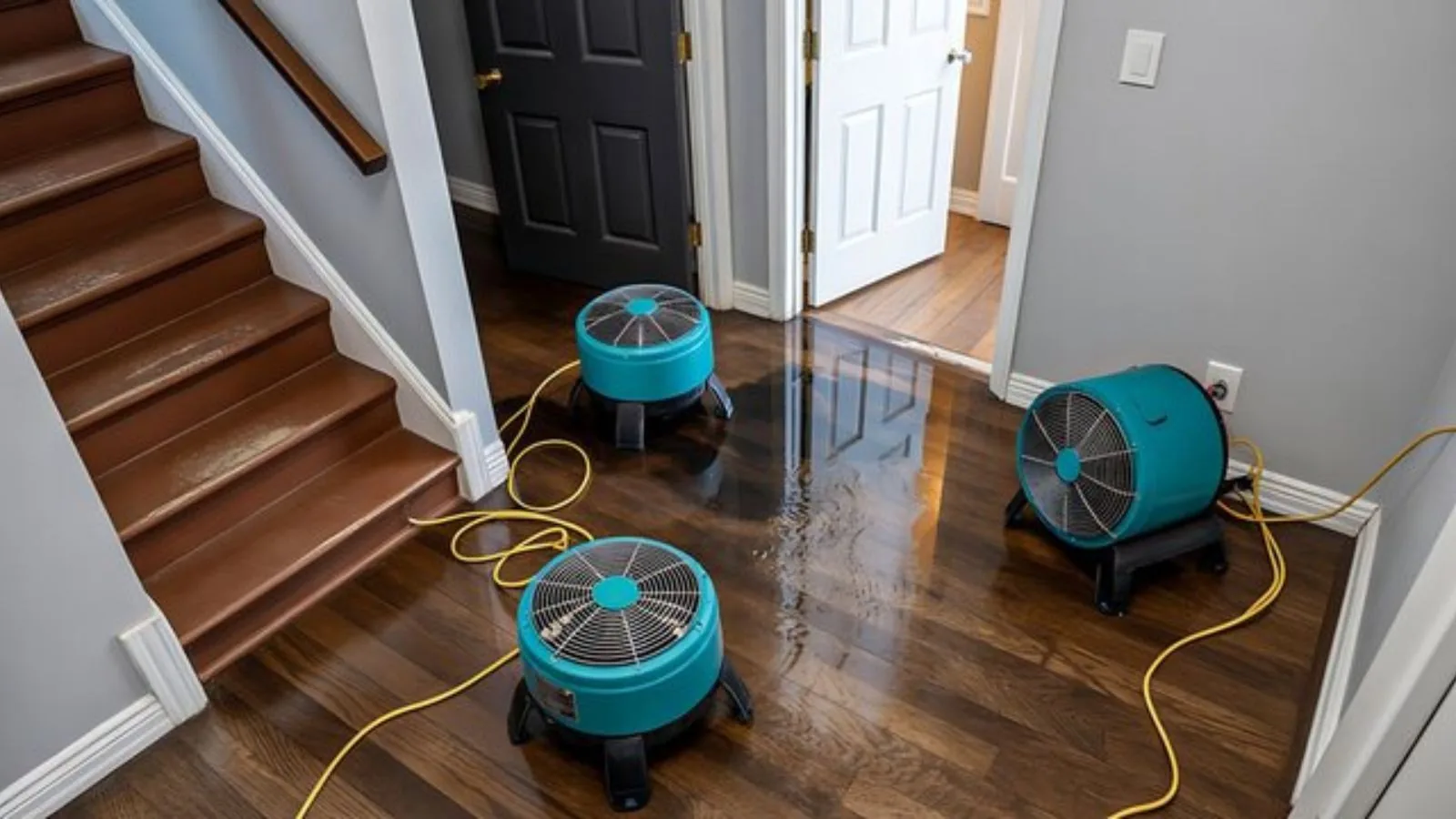
After a leak, the question that matters most is also the hardest to answer by eye: is it dry? Drywall, wood framing and concrete can hold water for weeks without showing it. Moisture meters and thermal cameras exist to answer that question with data. This guide explains what they measure, what the numbers mean and why a drying log is the only reliable proof that a house is dry.
None of the readings below should replace a professional assessment in a serious loss. They are meant to help a Morganville homeowner understand what a restoration crew is doing and to ask good questions.
Why wet materials do not always look wet
Building materials take on water slowly and release it slowly. Drywall may feel cool and dry on its face while its back and the insulation behind it stay saturated. A hardwood floor can look flat for days before it begins to cup. Concrete can look and feel dry while holding enough moisture to damage flooring laid over it.
That is why the EPA advises drying wet materials within 24 to 48 hours. After that, the chance of mold growth rises, and hidden moisture is what turns a small leak into a long-running problem. See mold remediation for what happens when moisture is left behind.
The tools and what each one does
| Tool | What it measures | What it cannot do |
|---|---|---|
| Pin moisture meter | Moisture in wood and drywall by electrical resistance | Reads only where the pins touch. |
| Pinless meter | Moisture below the surface by electrical field | Reads depth only a short way and can be thrown off by metal. |
| Thermal camera | Surface temperature differences that suggest wet areas | Does not measure moisture directly. |
| Hygrometer | Air temperature and humidity | Does not say what is in the materials. |
A thermal camera is a scouting tool. Wet materials often read cooler than dry ones because evaporation cools them, so the camera highlights areas to check with a meter. The meter then gives a number. Together they let a crew map a wet area without opening every wall.
What the numbers mean
Meters report different scales for different materials, so a reading means little without a reference. The standard approach, described in ANSI/IICRC S500, is to take a reading in a similar material in an unaffected part of the building and treat it as the dry standard for that house. Drying is complete when the wet area matches that standard.
This is why you may see a crew mark wet areas with tape and write numbers on the wall. They are tracking those spots day by day. If a reading flattens above the reference, something is still feeding the moisture, such as a hidden leak, a damp slab or high humidity in the room.
Humidity and drying in coastal New Jersey
The Office of the New Jersey State Climatologist at Rutgers reports a 1991 to 2020 normal of about 47.6 inches of precipitation a year statewide, with coastal areas receiving less, in the range of 40 to 45 inches. Humidity is a bigger factor than rain totals for drying, since summer air in this part of Monmouth County holds a lot of moisture that dehumidifiers must work against.
That is one reason drying takes days and not hours. A closed room with a dehumidifier dries faster than an open one, and an outdoor breeze on a humid day can slow the work instead of helping it.
Source type: Rutgers Office of the New Jersey State Climatologist data and EPA moisture guidance.
The drying log
A good restoration job produces a log: the date, the room, the reading in each tracked spot, the equipment running and the air conditions. The log shows the trend. Readings fall steadily as drying works. They stall when something is wrong. At the end the log proves to you, your insurer and any buyer that the structure was dried to the standard.
Ask for a copy. If a contractor will not share readings or cannot explain what they mean, that is worth noticing. See water extraction for how the first stage hands off to drying.
What homeowners can do with a meter
Consumer moisture meters exist and are useful for screening. Use one to check suspect spots, such as the base of a wall under a window or the floor beside a dishwasher. Compare a suspect spot with a spot you know is dry and see whether the number differs. A difference is a reason to call, not a diagnosis.
- Test the same spots weekly after a leak to see whether numbers hold.
- Check the back of a cabinet or the wall behind an appliance.
- Look for rising readings after rain, which can point to an exterior source.
- Photograph the meter display next to the spot you tested.
Where readings matter most nearby
Homes in Matawan with finished lower levels and homes in Spotswood near the brooks are the ones where moisture hides most often, because concrete slabs and block walls hold water. For those, readings in the slab and the base of the walls matter as much as readings in the drywall.
What to do if your own readings look high
Do not tear anything open. Note the number, the spot and the date, and compare it with a dry spot. Check for an active source such as a drip or condensation. If the reading stays high after a day of ventilation and a dehumidifier, call for a professional check.
Questions to ask a contractor about readings
- Which meter do you use, and what does it measure?
- What is the dry reference for this house?
- How often will you take readings, and can I see them?
- What do you do if a reading stalls above the reference?
A contractor who answers these without hesitation has a process. One who answers vaguely may be drying by habit rather than by data.
Want readings taken? Call the line and describe what you noticed.
Call (732) 352-9660Frequently asked questions
No. A moisture meter measures moisture, not mold. Mold needs moisture, so a high reading is a reason to inspect, but mold is confirmed by inspection and sometimes sampling.
It depends on the meter and the scale. The reliable approach is to compare a suspect area with a dry area of the same material in the same house.
Usually at the start and at each visit, often daily for the first few days. The log shows the trend.
No. The camera shows temperature differences. The meter measures moisture.
Coastal New Jersey summers are humid, so air that holds a lot of moisture slows drying and requires dehumidification to pull it out.